Owners who have finished with firewood nearly always open with one question: which gas route should we take? Around Riverside the answer turns less on taste than on two practical points, how much warmth you want the fireplace to give and what condition the chimney is in. Each option below gets its own section, then we cover what settles the choice.
Option one: vented gas logs
With vented logs, ceramic pieces rest over a steel burner tray that sits in your existing firebox. The flame is tall and yellow and reads as a wood fire from across the room. Because the front stays open, most of the warmth rises straight up the flue, so the room itself barely gains a degree. That also means the chimney has to keep working exactly as it was built: the flue sound, the cap on, and a clip on the damper so it can never shut fully while the burner is lit. Logs cost the least of the three to buy and fit, and the work is short. They are a look rather than a heater. Log sets carry no fixed figure on our list; you get a written price after we have measured the firebox and checked the gas valve. Our gas logs page covers the work in more detail.
Option two: a gas insert
An insert is a sealed steel box with a glass face that slides into the old firebox. Outside air comes in and exhaust goes out through stainless pipe threaded up the inside of the chimney, so the air you breathe plays no part in the fire. What you get is a true heater: warmth comes off the glass and out of the blower into the room rather than up the stack. Installed inserts run $2,750 to $5,500 on our list. The chimney still matters because it holds the vent, but it no longer has to be a flawless wood flue. A cracked clay tile, for instance, matters far less once a sealed pipe runs through it. See fireplace inserts and our insert price breakdown.
Option three: a direct-vent unit in a new spot
A direct-vent fireplace is a whole gas appliance framed into a wall, with its own vent going out the side of the house or up through the roof. It needs no chimney at all. That makes it the answer when the old stack is too far gone to save, when the fireplace sits in a room nobody uses, or when the house never had one. It also costs the most, $4,400 to $8,800 on our list, because it means framing, finishing and cutting a new vent through the outside wall. Some owners pair it with taking down a tired brick chimney; that becomes a chimney rebuild question with a quote of its own.
The three at a glance
- Warmth in the room: logs give little; an insert and a direct-vent unit give a lot.
- Uses the old chimney: logs need all of it working; an insert uses it as a sleeve for the vent; a direct-vent unit ignores it.
- Glass front: logs, no; the other two, yes.
- Our price: logs, written after measuring; insert, $2,750 to $5,500; direct-vent in a new place, $4,400 to $8,800.
- Damper: logs need it clipped partly open; an insert vent usually passes it; a direct-vent unit has none.
What settles it for your house
Three questions decide most cases.
How much heat do you want? If the answer is "enough to skip the furnace on a cool night", logs fall away and the choice is between the other two.
What shape is the chimney in? A split crown, a stack that has shifted or a flue that failed its last camera run makes logs a poor match, since they rely on the chimney exactly as built. An insert forgives more, and a direct-vent unit sidesteps the chimney entirely. A Level 2 inspection at $385 answers this for certain instead of by guesswork.
Is there gas at the fireplace now? Some older houses still have a valve beside the firebox from an old log lighter. If yours does not, a supply line has to be run, and that is priced as its own item.
Once you know which way you lean, the quote form gets things moving: say which of the three you are weighing and whether a gas valve sits at the hearth, and we will call to set a visit and follow it with a written price.
The face of the fireplace
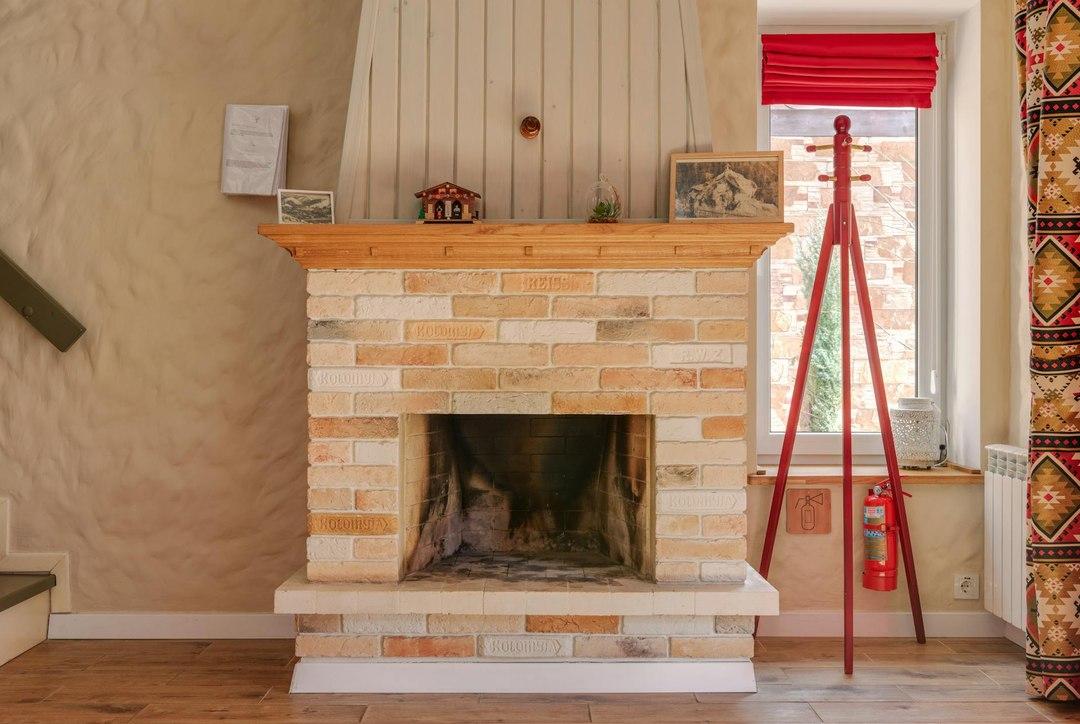
Whichever route you take, the front of the fireplace usually changes too. Logs keep the old opening as it is. An insert covers the opening with a trim panel that can sit inside the existing brick or a new face. A direct-vent unit gets a surround built from scratch. If the brick or tile has dated badly, this is the time to change it, since the hearth is opened up anyway. We price fireplace remodel work on the same quote as the gas unit so the two are planned as one job.
Repairs after the switch
Gas appliances need far less attention than a wood fire, but they are not set and forget. A yearly service keeps the burner, igniter and glass in order, and if something stops working, our gas fireplace repair visits cover inserts, logs and direct-vent units alike, whoever fitted them.
Riverside air rules and the switch
Riverside sits inside the South Coast air district, and on winter nights when the air is stagnant the district can bar wood fires under its Rule 445. Gas fireplaces fall outside those bans, which for many owners settles the matter on its own. We work across Riverside, Claremont, Brea and Yorba Linda, all under the same district.
Still torn between two of the three? Start a conversation through the contact page and we will help you narrow it to one.
Ready for a Look at Your Flue?
Easley Chimney Contractors works out of Riverside. We check the chimney, then lay out gas logs, an insert or a direct-vent unit, whichever the house can take, each with its own figure.